Road races and runs

Four hundred runners, one hour, no printed list.

A wedding trickles in across an afternoon. A race does not. The whole field arrives in the hour before the gun, at one gate, and every one of them is a single entry. In the screenshot below, 312 of 359 expected runners were scanned in inside that hour — bucketed by five minutes, because that is how fast it moves.

Create your workspaceStart planning for free.
One entry, one runner, one placeCheck-in on a phone at the gateNo michango ledger — a race has entry fees
The arrivals report for a marathon, showing 312 of 359 expected seats arrived and a histogram of admissions in five-minute buckets peaking mid-hour.

The hour

The queue builds, and you can watch it build.

Registration opens ninety minutes before the start and almost nobody comes early. Because the whole thing happens inside an hour, the arrivals chart buckets by five minutes rather than by the half hour — so you see the queue forming and clearing instead of one flat bar for the morning.

  • Five-minute buckets when arrivals run under an hour
  • First arrival, last arrival, and the busiest five minutes
  • Admissions counted per sitting: registration, race, awards
The marathon arrivals histogram, with five-minute bars rising to a peak and a turnout figure of 87 per cent.

The gate

The gate is a phone, not a clipboard.

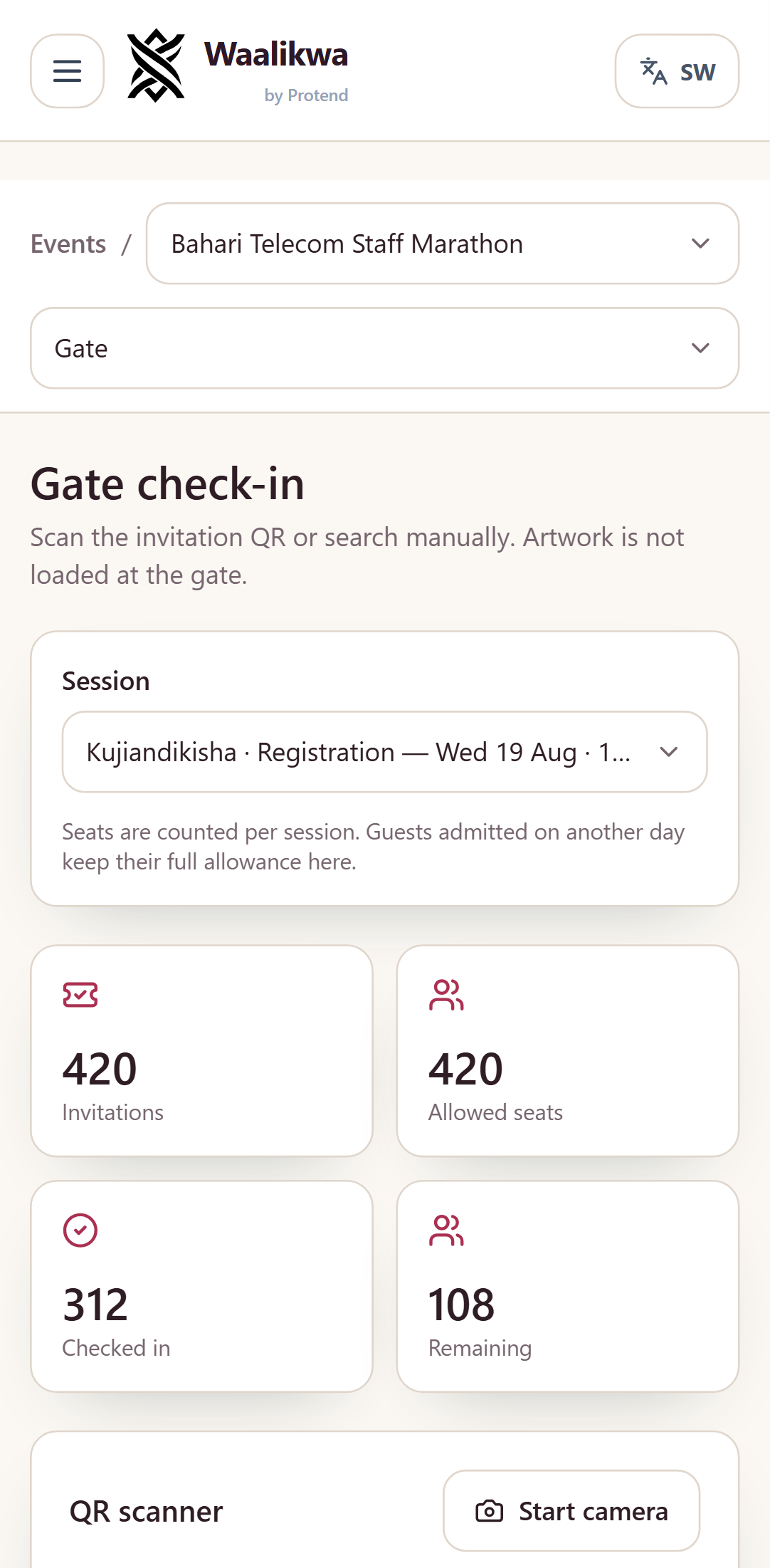
No printed list, no laptop on a trestle table in the sun. A marshal opens the gate screen on their own phone, scans the code on the runner's card or types the six characters underneath it, and the count goes up. Two marshals scanning the same runner is one admission, not two.

  • Scan the code, or type six characters
  • Runs on the marshal's own phone
  • Checking the same runner in twice still admits them once
  • Gate staff see only the event they are working
The gate check-in screen on a phone, with a scanner, a code entry box and a running count of runners admitted.

The field

Four hundred and twenty entries, every one of them one runner.

There are no family blocks in a race field. Every entry admits one person, so the number of entries and the number of people are the same number, and the gate is counting heads rather than doing arithmetic on somebody's cousins.

  • Every entry single, with one place against it
  • Search by name, phone or entry code
  • Import the field from the spreadsheet the registration form produced
A marathon entry list of several hundred runners, each row a single entry admitting one place.

The code

A code per runner, sent before race day.

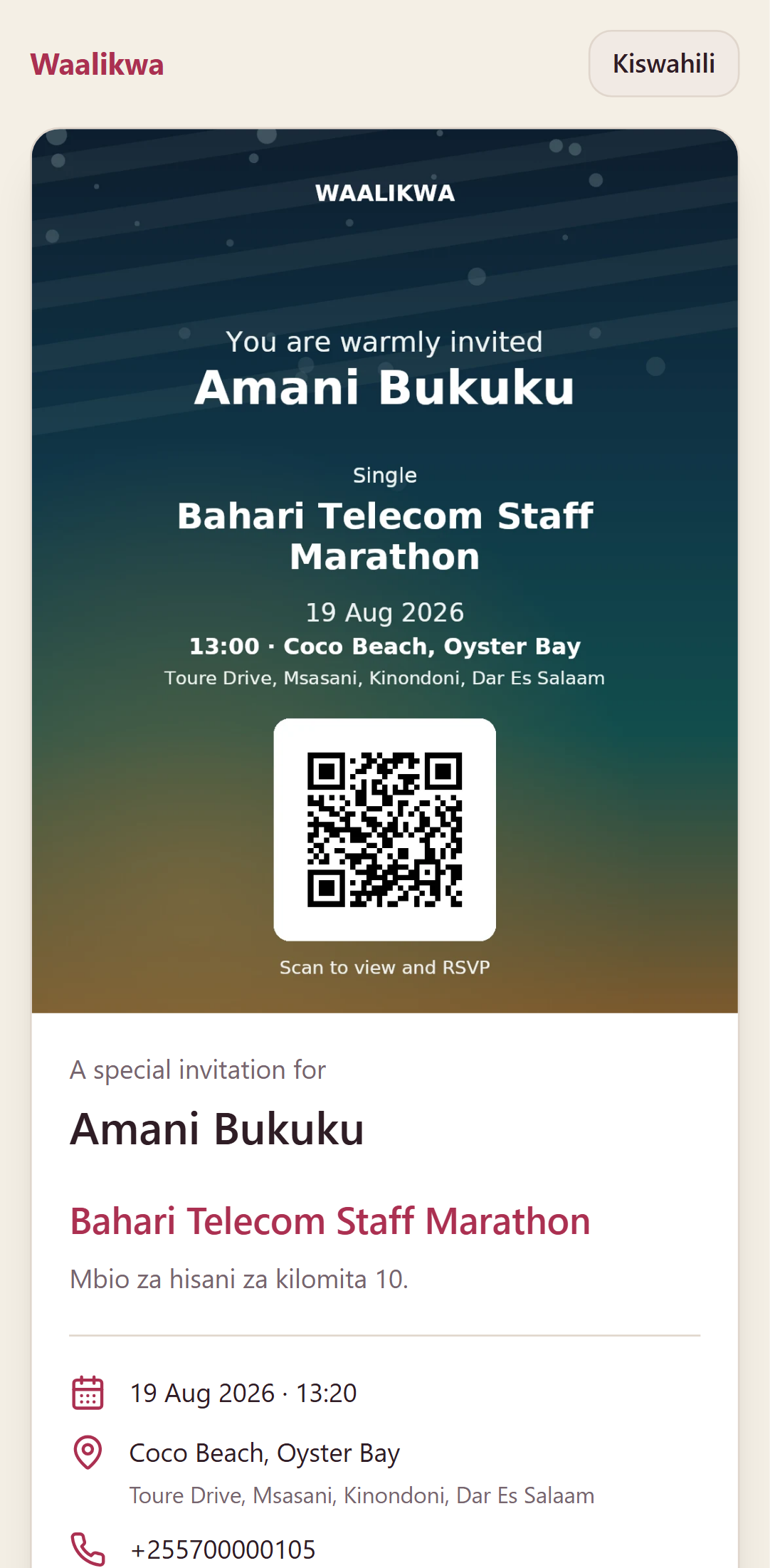
Each runner gets a card with a code on it, which is the thing the gate reads. Generate the artwork for the field, or for the first dozen and the rest later — the code works whether or not anyone has drawn the card.

  • Six characters, unique to that entry
  • The code admits them whether or not the artwork was generated
  • Sent from your own number, like every other invitation
A marathon entry card as the runner sees it on their phone, reading Single above the race details and a scannable code.

What is not here

There is no michango ledger on this page.

A road race collects entry fees through whoever is selling places; it does not run a committee, take pledges at a meeting, or chase instalments for a month afterwards. The ledger exists in Waalikwa and it is genuinely useful — for weddings, send-offs and funerals. For a race it would be a screen nobody opens, so this page does not pretend otherwise.

  • No committee, no pledges, no instalments
  • The ledger is there if a future event needs it

Bring the entry list, hand out the codes.

Import the field, generate the codes, and put the gate screen on as many marshals' phones as you need on the morning.

Create your workspace